
by Madeline Hunter
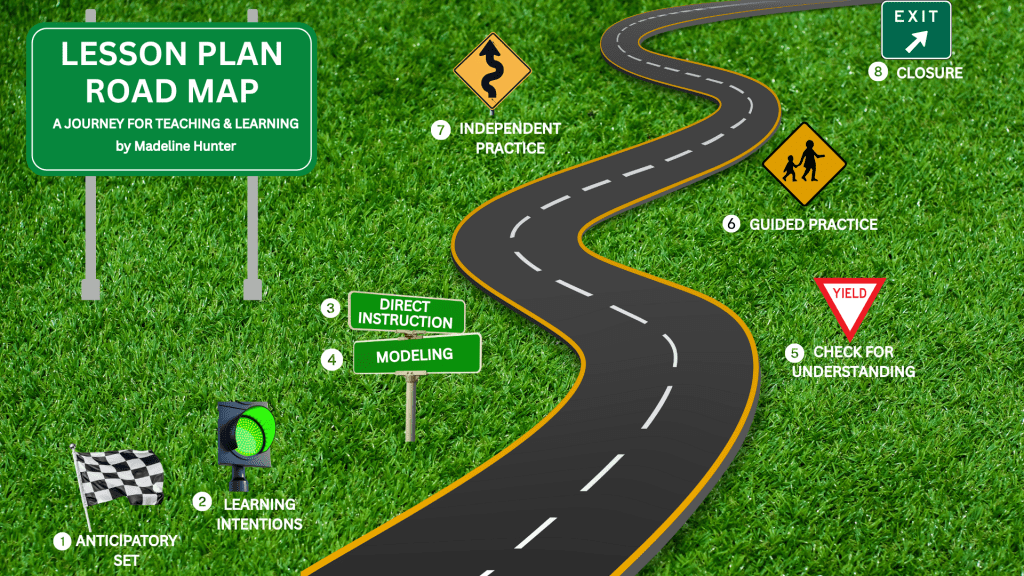
Hit the interactive Lesson Plan Road Map to join the journey! Learn tips and techniques to help you implement the classic, tried-and-true 8-step lesson plan designed by Madeline Hunter. Each road sign is clickable. Discover also how to use the Road Map strategy for teaching and learning!
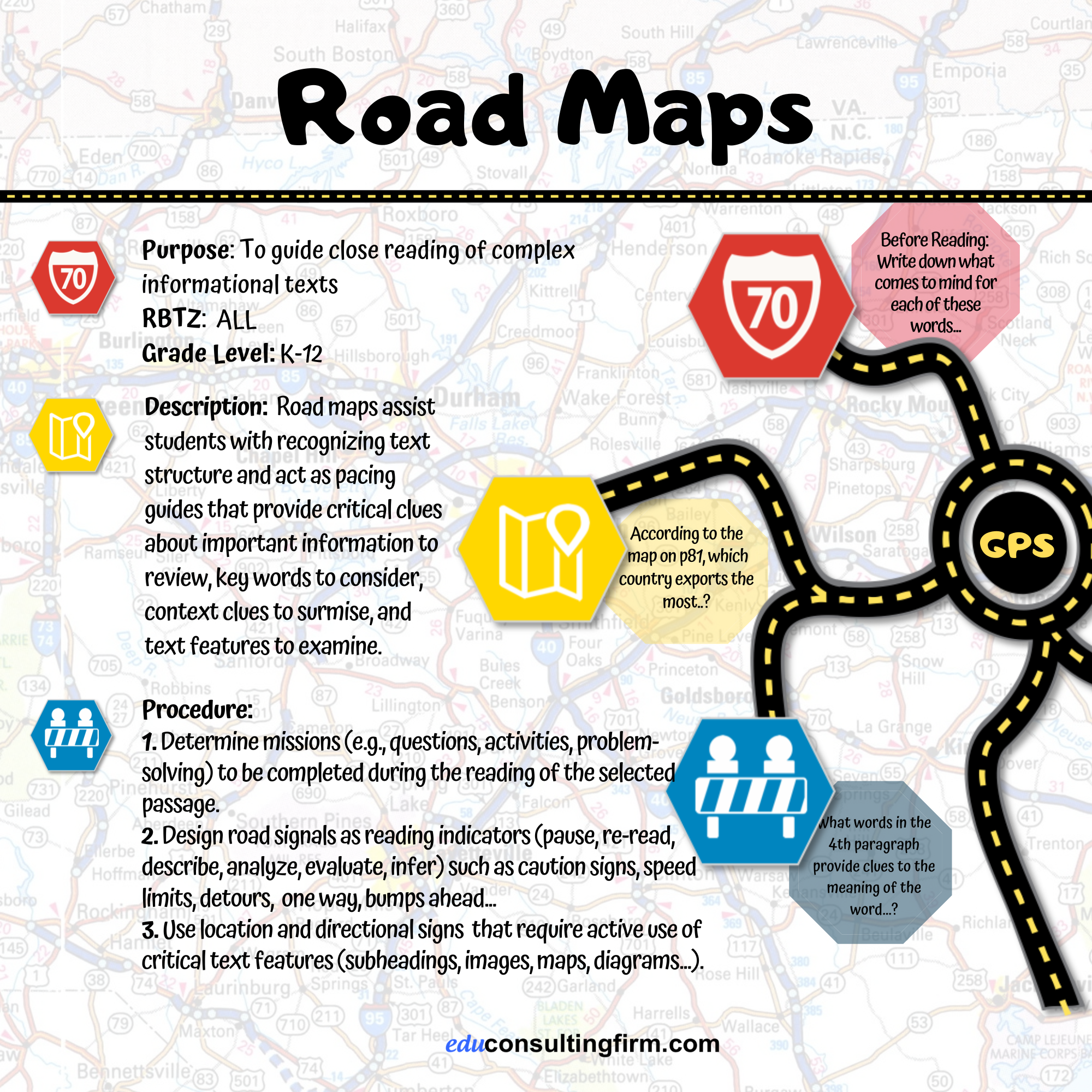
Road Map Strategy
by Karen Wood

TEMPLATES
Need some road map template ideas?
Road maps can take many forms–they do not literally have to be a road. Turn any process into a journey:
- Cooking → “Recipe for Success”
- Building → “Blueprint for Understanding”
- Time Travel → “Fix the Past to Save the Future”
- Ocean Dive → “Explore Deeper Levels of Understanding”
1. The Learning Garden
- Format: Each step is a plant in the garden (seed → sprout → flower → fruit).
- Student Interaction: Students “water” a plant (answer a question), “prune” it (fix an error), or “pollinate” (connect ideas).
- Use for: Growth mindset lessons, writing process, or science cycles.
🧩 2. Puzzle Path
- Format: Each task is a puzzle piece that connects to the next.
- Student Interaction: Students must “earn” each piece by solving a problem or interpreting a text.
- Use for: Reading comprehension, math problem-solving, or grammar review.
🚀 3. Mission to Mars / Space Journey
- Format: Each “stop” is a planet, asteroid, or space station.
- Student Interaction: They complete “missions” (mini-tasks) to collect fuel or data to reach the final destination.
- Use for: Inquiry projects, STEM units, or narrative writing.
🏰 4. Castle Quest / Dungeon Crawl
- Format: Students move through rooms or towers in a castle.
- Student Interaction: Solve riddles, decode clues, or complete challenges to “unlock” each door.
- Use for: Literature studies, history timelines, or vocabulary review.
🧠 5. Mind Map Adventure
- Format: A branching mind map that feels like a web of choices or discoveries.
- Student Interaction: At each node, they choose a path — “What happens if you infer vs. summarize?” — and follow that branch.
- Use for: Critical thinking or decision-based learning.
🪄 6. Magic Potion Lab
- Format: Each task represents an ingredient for a potion.
- Student Interaction: Students “mix” ingredients by completing problems correctly; incorrect answers “spoil” the potion.
- Use for: Chemistry, word study, or fractions.
📜 7. Storybook Journey
- Format: A giant open book, where each page represents a stage of the story or topic.
- Student Interaction: Annotate the “pages,” answer comprehension prompts, or write a short addition before turning to the next.
- Use for: Reading sequences, history, or narrative writing.
🐾 8. Animal Migration Map
- Format: Show a journey across habitats or regions.
- Student Interaction: Students “migrate” by completing checkpoints related to the topic (e.g., solving math problems to cross rivers).
- Use for: Geography, ecosystems, or cumulative review.
🔮 9. Crystal Maze / Labyrinth
- Format: A branching maze where students must make decisions at each turn.
- Student Interaction: Each choice depends on correct reasoning or evidence from the text/problem.
- Use for: Argument writing, critical reading, or logic puzzles.
🧗 10. Mountain Climb / Expedition Map
- Format: A vertical chart that climbs to a peak goal.
- Student Interaction: “Climb” by completing problems or reflecting at base camps.
- Use for: Goal-setting, multi-step math, or skill progression.
 eduChalkboard